Software Engineering
Custom Software vs Off-the-Shelf Software: Which Is Better?
Neither option is better in the abstract. What decides it is how unusual your process is, how much integration you need, and how long you expect to live with the choice.
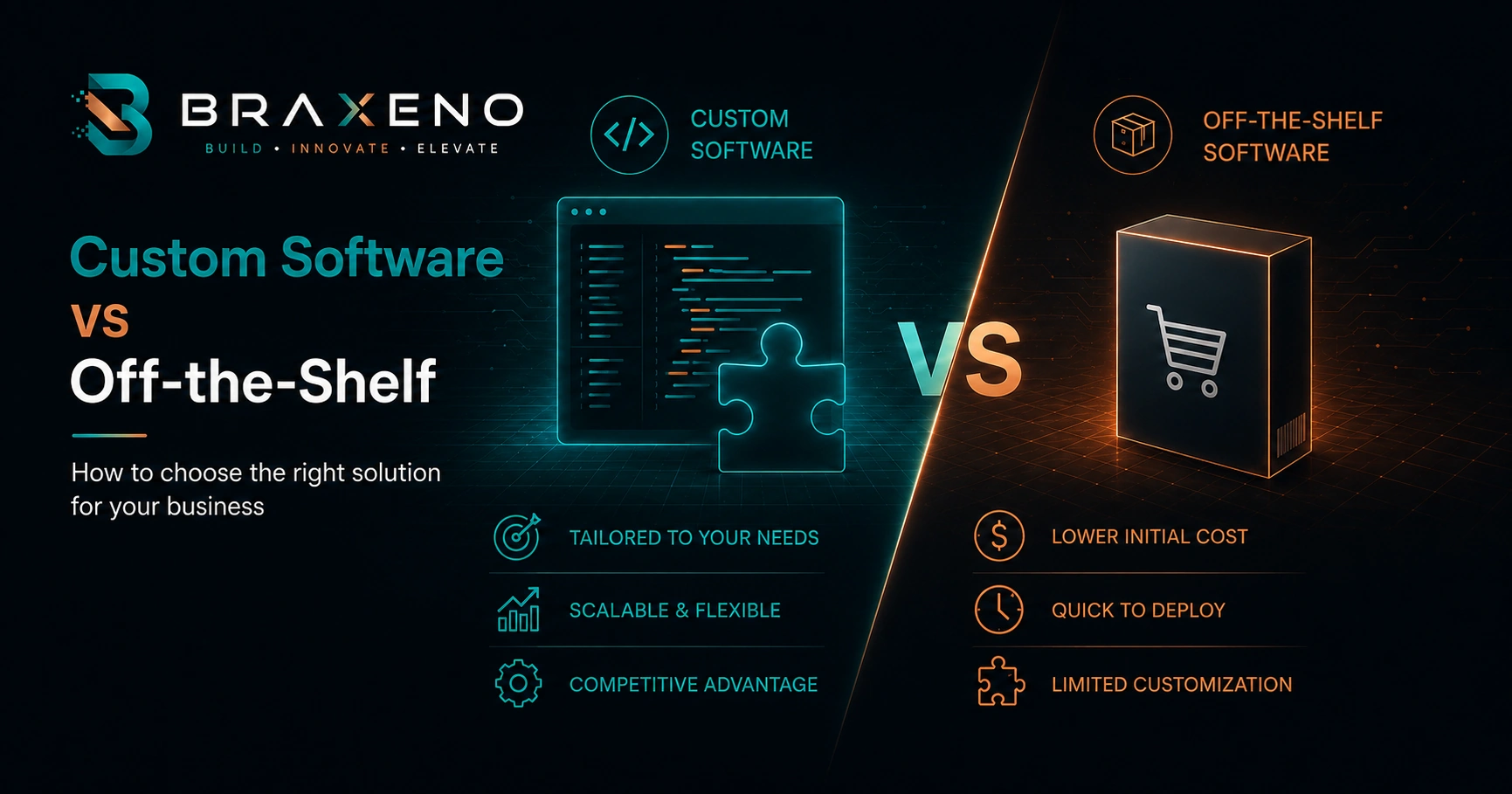
"Should we build this or buy it?" is usually asked too late — after a team has already spent six months forcing a product to behave in a way its designers never intended, or after a bespoke system has been built to replicate something available for a monthly subscription.
The honest answer is that neither option is better in the abstract. What decides it is how unusual your process is, how many systems it has to touch, and how long you expect to live with the consequences. This article gives you a way to work that out before committing.
What Each Option Actually Is
Off-the-shelf software is a product built for a market. Its feature set is the intersection of what many organisations need, and its roadmap is set by whoever pays the most attention — usually not you. You get maturity, support, and a low starting cost, in exchange for accepting someone else's model of how the work should be done.
Custom software is built around one organisation's process. It does exactly what you specify and nothing you did not ask for. You own the roadmap, the data, and the maintenance burden that comes with both.
There is a third option that is frequently the right one and rarely considered explicitly: buy the commodity parts and build only the layer that is genuinely yours. Accounting, payroll, email, and storage are solved problems. The specific way you quote a job, schedule a crew, or price a contract may not be.
The Comparison That Matters
Feature checklists are a poor basis for this decision, because every product looks adequate on a checklist. These dimensions discriminate better.
| Dimension | Off-the-shelf | Custom software |
|---|---|---|
| Time to first use | Days to weeks | Weeks to months, depending on scope |
| Upfront cost | Low — subscription or licence | Higher — it is a build |
| Ongoing cost | Per-seat fees that grow with headcount | Hosting, maintenance and ongoing development; scaling pattern depends on usage and architecture |
| Process fit | You adapt to the product | The product adapts to you |
| Integration | Limited to the vendor's API and connectors | Whatever you are willing to build |
| Data ownership | In the vendor's system, exportable in their format | Yours, in a schema you control |
| Change velocity | Request it and wait, or work around it | Prioritised by you, cost borne by you |
| Risk | Vendor pricing, roadmap and continuity | Build quality, key-person dependency, maintenance neglect |
When Off-the-Shelf Is the Right Answer
Buy when the process is standard, well-served, and not a source of competitive advantage. If thousands of businesses do this the same way you do, someone has already built it better than a first version of yours would be.
- Regulated or standardised domains — payroll, tax filing, statutory accounting — where compliance updates are the product.
- Commodity infrastructure: email, calendars, file storage, video calls, password management.
- Anything where you need to be running next week rather than next quarter.
- Processes you have not yet stabilised. Rent flexibility until you know what you actually need.
- Small teams where the per-seat cost stays modest for the foreseeable future.
When Custom Software Is the Right Answer
Build when the process is the differentiator, when the integration surface is wide, or when the workarounds have quietly become the system.
- The workflow is your advantage. If how you do it is why customers choose you, generic software will average it away.
- You are running the business in spreadsheets alongside the product. That gap between tool and reality is a specification for something bespoke.
- Several systems must agree. When work spans a CRM, an ERP, a scheduling tool and a warehouse system, the value is in the connective layer — and no vendor sells yours.
- Per-seat costs are outgrowing the value. Licence fees often scale directly with seats; custom software costs usually scale differently through infrastructure and maintenance. There is a crossover point, and it is worth calculating rather than assuming.
- You need data you cannot get. If the reporting you need is impossible because the product does not model your entities, no amount of configuration will fix it.
How to Compare Cost Honestly
Most build-versus-buy comparisons fail because they set a one-off development quote against a monthly subscription and stop there. Compare the same things on both sides, over the same horizon — three years is usually long enough to be meaningful and short enough to be predictable.
Count every seat, tier and add-on
Include the premium plan you will need for the API access, the integration surcharges, and the seats you will add as you grow.
Cost the workarounds
Manual re-keying, weekly exports, the spreadsheet somebody maintains. Put hours against them. This is the line item that is always missing.
Include implementation on both sides
Buying is not free to adopt — configuration, data migration and training are real. Building is not finished at launch.
Budget for maintenance, not just the build
Custom software needs dependency updates, security patches and small changes. Plan for a recurring allocation rather than pretending it is zero.
Price the exit
What does it cost to leave? For a product, that is data export and migration. For a build, it is who else can maintain it. Both are real costs.
Done properly, this comparison often produces a less dramatic result than either side expects. Buying is rarely as cheap as the sticker price; building is rarely as expensive as the initial quote suggests once the workaround hours are counted. Putting a credible figure on the build side is its own exercise — what drives custom software development cost covers which decisions move the number and how to read a quote.
The Hybrid Approach
In most engagements the right architecture is neither pure build nor pure buy. Keep the established products where they are strong, and build a thin custom layer that holds your process and connects them.
That layer typically owns three things: the workflow logic that no product models correctly, a normalised view of the records that several systems each hold a partial copy of, and the interface your team actually works in. Everything else stays where it is, reached through APIs.
This approach keeps the build small, which keeps it maintainable. It also reduces the biggest risk of a full custom project — that you rebuild a great deal of commodity functionality badly. Where the connective work is the whole project, API integrations between business tools may be all you need.
A Decision Checklist
Before committing either way, work through these in order. If you cannot answer one, that is the next thing to find out rather than a reason to guess.
- Write down the process as it runs today, including every workaround.
- Trial the two strongest off-the-shelf candidates against that written process, not against a demo script.
- List precisely which steps they cannot support, and how much each gap costs per month.
- Model three years of total cost for buy, build, and hybrid.
- Decide which parts are genuinely differentiating — those are the only candidates for a build.
- Choose the smallest version of the chosen option that solves the top two gaps, and ship that first.
If the outcome points towards building, the follow-up question is what the project actually involves. The custom software development process walks through what happens from discovery through to launch.
Final Thoughts
Buy the commodity. Build the difference. The failure cases in both directions come from the same mistake — treating the decision as a matter of preference rather than working out where your process genuinely departs from the standard one.
Write the process down first. The answer is usually visible once it is on paper.
Written by Braxeno
Braxeno builds AI automation, custom software and SaaS products for growing businesses. Everything we publish comes out of work we have actually shipped.